It’s too loud!
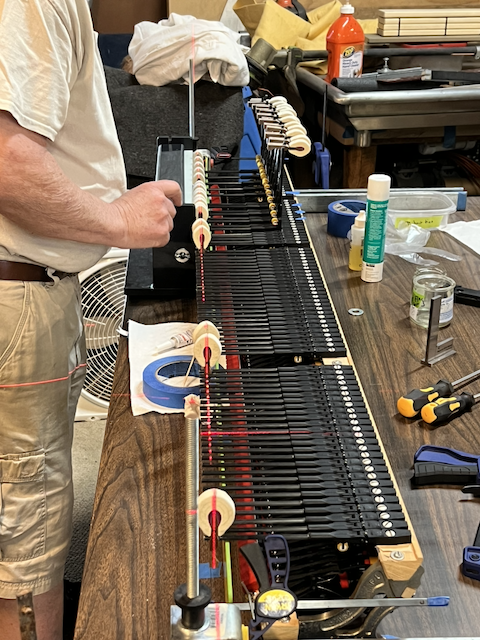
“It's too loud!" is one of the most common things I hear when I open a piano lid. Sometimes it's a parent whose teenager's practice rattles the whole house. Sometimes it's a pianist who says the top octaves have turned glassy and piercing, or that the piano "shouts" no matter how gently they play.
Sometimes it’s a brand new piano that sounded OK in the shop but now that it’s in my house it is just too loud for the space.
The good news: a piano's tone is not fixed. Much of what you hear is shaped by a small part of the instrument you may never have looked at, and a technician can adjust it. That adjustment is called voicing, and this post explains what it is, why pianos drift toward brightness over the years, and what can and can't be done about it.
What voicing is
Voicing is the adjustment of the piano's hammers to change the tone they produce. Each key throws a felt-covered wooden hammer against its strings, and the felt's hardness and shape decide much of what you hear.
Think of a percussionist playing a xylophone. Strike the bars with hard plastic mallets and the sound is bright, loud, and cutting. Switch to soft yarn mallets, and the same bars sound round and mellow. Nothing about the bars changed; only what hit them.
Piano hammers work the same way. A new hammer is made of wool felt pressed under great force around a wooden core, so it is firm inside and a little more resilient at the surface. When that surface is springy, the hammer stays on the string for a slightly longer instant and excites fewer of the high, harsh overtones and fills out the lower overtones to create a more rounded, warm sound. When it is hard, contact is shorter and sharper, and the tone gets brighter and louder.
The effect is large. Researchers at the Royal Swedish Academy of Music measured that voicing a too-hard hammer can cut the upper limit of the tone's spectrum roughly in half, from about 8 kHz to about 4 kHz (Askenfelt & Jansson, Five Lectures on the Acoustics of the Piano). Your ear hears that as the difference between "shrill" and "warm."
Why pianos get louder and brighter over time
Most pianos don't start out too loud. They get there gradually, a few thousand notes at a time, which is why owners often don't notice until a guest or a new teacher points it out.
Compacted felt. Every blow packs the felt at the striking point a little tighter. Over years the springy surface turns hard, and the tone hardens with it.
String grooves. The strings cut small grooves into the hammer's crown. A grooved, flattened hammer strikes with a hard, broad face instead of a rounded point, adding a metallic edge.
Uneven wear. The notes played most (the middle of the keyboard, and whatever keys a student's repertoire favors) wear fastest. The result is a piano that is mellow in one octave and brash in the next.
Humidity. Felt is wool, and wool responds to moisture. Our dry Sacramento-area summers can make hammers feel harder and brighter than they do in a damp winter.
A useful comparison is a new pair of running shoes. The cushioning feels great at first, but after a few hundred miles the foam is compressed and every step jars a bit more. The shoe looks fine; the spring is gone. Hammer felt ages the same way.
It might not be the piano
Before anyone touches a hammer, it's worth looking at the room. Modern homes, with hardwood or tile floors, tall ceilings, big windows, and minimal furniture, act like a gymnasium: every note bounces back several times before it fades. A piano that sounded fine in the showroom can sound overwhelming in a living room with nothing soft in it.
Things you can try yourself, at little or no cost:
Add soft surfaces. A thick area rug under or in front of the piano, upholstered furniture, curtains, and full bookshelves all absorb reflections.
Move it off the wall, or turn it. An upright pushed tight against a bare wall, or tucked into a corner, can boom. A few inches of space, or a different wall, can help. Hanging a moving blanket behind an upright can help mute the strident sound.
Close the lid. On a grand, lowering the lid to the short stick or closing it fully takes a noticeable edge off. On an upright, keep the top closed and the front panels on.
If the room is doing most of the damage, voicing the piano very soft to compensate can leave it dull when you move or furnish the space differently. It's usually best to address both together.
What the technician does
Voicing is the last step of a sequence, not the first. Voicing an out-of-tune or poorly regulated piano is like adjusting the seasoning before you've finished cooking: you'll just have to redo it. A typical job runs in this order:
Tune. Out-of-tune unisons (the two or three strings of a single note) sound harsh on their own. A stable tuning comes first so the technician is judging the hammer, not the tuning.
Regulate. The action's adjustments control how far each hammer travels and how it meets the string. A hammer that doesn't strike squarely, or that blocks against the string, can sound as bad as a hard one.
Reshape. Worn, grooved hammers are filed with fine sandpaper to restore a rounded crown and remove the hard, compacted outer layer. This alone often softens the tone considerably.
Needle. Using a tool with one to three fine needles, the technician carefully pierces the felt at chosen spots on the hammer's shoulders and crown. This loosens the fibers and restores some of the springiness.
Even out. Finally, notes are compared with their neighbors and adjusted one by one, so a scale sounds like one voice rather than a mix of loud and soft notes.
Needling is done a little at a time, with lots of listening in between, for one important reason: it can't be undone. Once felt is over-softened, it can't be made satisfactorily firm again, and the tone goes dull and weak (Askenfelt & Jansson). A cautious technician would rather leave a piano slightly bright and come back than overshoot.
The process also works in the other direction. For a piano that sounds dull or mushy, a technician can firm up the felt with a diluted hardening solution. And if hammers are worn down too far to reshape, replacing them is the real fix.
Realistic expectations, and when to call
Voicing can make a real difference, but it works within the piano's design. It can tame a harsh piano, even out an uneven one, and bring back tone lost to wear. It won't turn a small console into a concert grand, because size, soundboard, and scale design set the outer limits.
It's time to have your piano looked at if:
The new piano just sounds louder than you remember it in the store.
It sounds noticeably louder or harsher than it used to.
A few notes stick out, brighter or duller than their neighbors.
You can't play softly, even with a light touch.
The piano sounds fine in one room but overwhelming in its new home.
It has been several years since the hammers were last reshaped or voiced.
If your piano has become too much of a good thing, I'm happy to take a listen.
To schedule a visit or ask a question, contact me by calling 916-261-2419 or through the contact page at pianotraditions.com. I serve Folsom, El Dorado Hills, Granite Bay, Rancho Cordova, and the greater Sacramento area.