Is Your Grand Piano Asking for Regulation? Signs to Watch For
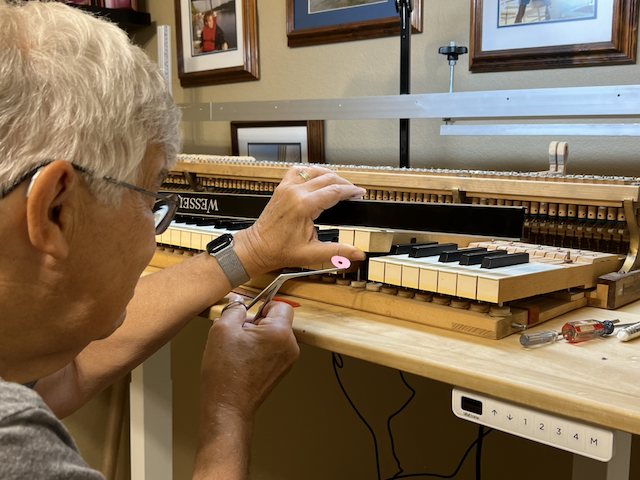
If your grand piano is in tune but still feels uneven, heavy, or hard to control, it probably needs regulation. Tuning fixes pitch. Regulation fixes how the piano responds to your fingers.
A grand piano action has thousands of parts, dozens behind every key: wood levers, felt cushions, cloth bushings, springs, and hammers. Each key has dozens of adjustments that must work together to a fraction of a millimeter. Regulation is the process of measuring and resetting all of them, so every key behaves correctly and in the same way.
Think of it like a car's wheel alignment. The car still drives when the alignment drifts, but it pulls, wears tires unevenly, and never feels quite right. You usually don't notice until someone sets it back to spec, and then the difference is obvious.
But how do I know if my piano needs to be regulated?
First, when quoted $150, you need to know what that covers. Is this for a complete tuning, an hourly rate, a flexible amount depending on what the technician may find when he sees the piano. I try to keep it simple. It takes me typically 1.5 hours to tune a piano that is in Why a good piano drifts out of regulation
Regulation deteriorates gradually over years, so the change is almost impossible to notice day to day. A few things are always at work:
Felt compresses. Every keystroke squeezes the felt cushions under the keys, under the hammers, and on the key frame. Thinner felt means more slack in the system.
Cloth bushings wear. The cloth that guides each key and pivot loosens, so parts wobble or click and sometimes stick.
Hammers wear and pack down. The felt on the hammer face flattens and grooves where it strikes the strings (more on this below).
Wood moves with humidity. Our Sacramento-area climate swings from dry summers to damp winters. Wood parts swell and shrink with it, and adjustments shift.
Springs and leather settle. Repetition springs weaken and leather surfaces glaze over time.
None of these changes are large. But a piano action works on tolerances of fractions of a millimeter, so small losses add up across 88 keys.
Would a new piano need to be regulated?
You would think not but this isn’t always true. Each manufacturer has a specification for regulation of their instruments, and these specifications are correct if everything during manufacturing is done perfectly. Unfortunately, this doesn’t always happen. After all, humans are doing much of the work manually.
When a piano is delivered to a dealer, the manufacturer expects the dealer to “prepare” the piano. This means more than just tuning it. It often requires regulation. Unfortunately, many music stores don’t have people qualified to do this work and think of it as too expensive for the typical piano purchaser. They feel this is the responsibility of the manufacturer. Then again, a lot can change between the time a piano is manufactured and delivered to the music store – particularly in terms of swings in humidity that make wood swell and shrink.
In addition, pianos are sold in stores with large rooms. Typically, the voicing is created loud enough to sound good in that room. This changes a lot when the instrument gets into a home. What sounded good in the store may not be appropriate for a residence. Ideally, a piano should be voiced to match the room it’s in.
If we lived in a perfect world, regulation of a new piano shouldn’t be necessary but often it is.
How can you tell?
Here are a few things that can tell you right away:
· Look at the hammers. If the tops of them are flat or heavily grooved, you need the hammers refinished and the action regulated.
· If the piano is too loud, then your hammers have hardened and need to be voiced.
· If the action feels either too heavy or even too loose, this gets in the way of your ability to play with any sensitivity and implies worn parts.
· If it tires your hands and arms to practice, regulation may be the real problem.
· If it’s difficult to play softly, this is another positive indication for need for regulation.
· If repeated notes don’t always sound clean, then the timing needs to be adjusted.
· If you hear double strikes when you play a note, this is typically a spring problem.
· If the piano squeaks and thumps you are probably annoyed by it already.
· If it has been many years since the piano was purchased and no regulation has been done, it certainly needs it.
How often should this be done?
Though concert instruments are constantly tweaked, home pianos don’t need this done very often. Unless they are played constantly, you probably don’t need to do this more than every 10 years or so.
Let's find out what your piano can do
Your grand piano was built to respond to the lightest touch and to sing with a full, rich tone. Years of playing gradually take that away, so slowly that most owners never realize how much has been lost.
The good news is that it can be restored. At your next tuning, ask me to evaluate the action and hammers. I'll measure let-off, drop, key dip, and hammer wear, show you what I find, and explain your options, from a touch-up to a complete regulation.
To schedule a visit or ask a question, contact me by calling 916-261-2419 or through the contact page at pianotraditions.com. I serve Folsom, El Dorado Hills, Granite Bay, Rancho Cordova, and the greater Sacramento area.