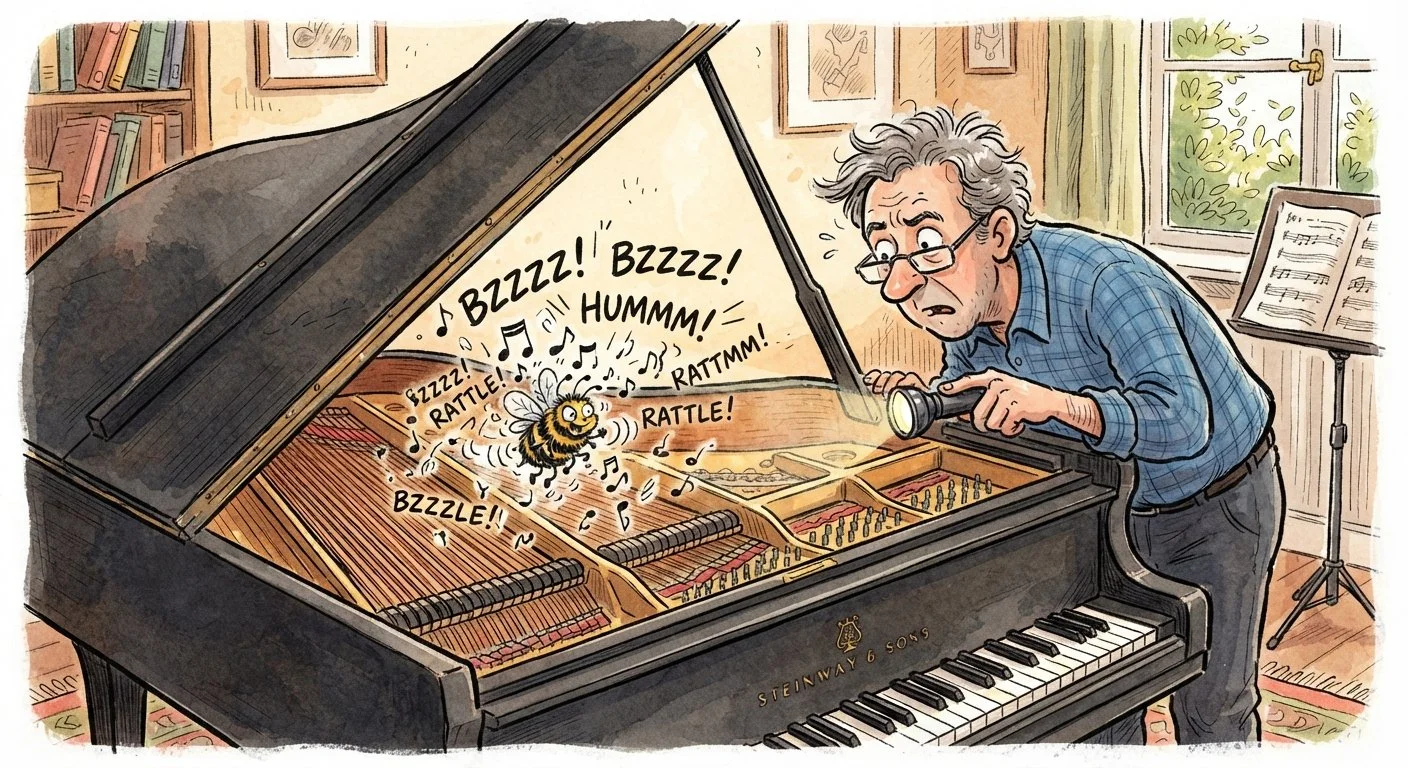
I recently had a client that complained about a buzz in his grand piano and asked me to come investigate. That’s always a difficult thing to diagnose given the many sources of a “buzz” in the piano. First and foremost, you need to understand what the client is actually hearing. Is it a mechanical buzz or is it something else. What I’ve found is that it is often a voicing problem especially when it occurs across many keys.
I collected all the sources of a buzz from various sources and have combined them in one place just to make it easier for someone to figure out the source.
Is it voicing?
If the sound crosses many keys and the sound of the piano is loud and brittle, chances are it is a voicing problem and can be reconciled by deep shoulder needling on the speaking side of the hammer. Sometimes, I will also use the hot water and alcohol approach in addition to needling.
What else is a buzz
A mechanical buzz is almost always two things in intermittent contact: one part is driven by vibration and taps against another instead of being either firmly coupled to it or clear of it.
That is why most buzzes are note-specific. The loose part only gets enough excitation near its own resonance, like a license-plate frame that rattles at one engine RPM and is silent at every other.
Causes by location
Buzz sources fall into five areas, listed here from the easiest to rule out to the most involved.
Outside the piano (rule these out first)
• Objects on the lid or music desk, picture frames, lamp shades, window panes, and HVAC grilles vibrating in sympathy.
• Pencils, coins, and paper clips lying on the soundboard or plate, or wedged against strings.
• On a grand, a pencil or toy behind the fallboard.
Case and hardware
• Lid hinges and their pins, the lid prop and its cup, and the front-flap hinge.
• The music desk and its slides, the fallboard, the key slip, and the lock.
• Pedal lyre braces, pedal rods, and trapwork; casters.
• Add-ons: humidity-control rods and wiring, player-system rails and cables, and mute rails.
Soundboard and bridges
• Ribs separated from the board, which is the classic dry-season buzz.
• Cracks whose edges rub together, or a board that has come loose from the inner rim.
• A warp in the soundboard that makes a bass string buzz against the plate
• Loose bridge pins, a delaminating bridge cap, or cracks running through the pin line.
• Poor notching, so the string leaves the bridge at the wood edge rather than cleanly at the pin.
• Loose nose bolts or plate screws.
Strings and terminations
• Loose windings on bass strings, which usually rattle more than they buzz.
• Capo bar grooving or poor seating, which gives the treble sizzle; worn or cracked agraffes.
• Noise from the front or rear duplex, and aliquots that have shifted.
• Strings touching a neighbor, a plate strut, or a damper wire.
• Missing or compressed listing felt, which lets the back lengths ring or touch.
Action and dampers
• Hard, deeply grooved hammers, which give a metallic "zing" at impact.
• Dampers that seat partially or lift unevenly, which buzz on release rather than on attack.
• Hammers grazing an adjacent string, especially with the una corda shifted.
• The sostenuto rod or its tabs, damper guide-rail bushings, and loose key leads.
Narrowing it down
Five steps isolate most buzzes, working from the note itself outward to the case.
1. Map it. Note which keys trigger it, and whether it comes on the attack, during sustain, or on release. A single-note buzz points to that note's strings, terminations, or damper. A buzz across a range around one pitch points to a sympathetic part elsewhere.
2. Mute within the unison. If the buzz follows one string, the cause is at that string's terminations or winding.
3. Test the pedals. If it changes with the damper pedal, suspect the dampers or trapwork. If it changes with the shift, suspect hammer-to-string alignment.
4. Press while a helper plays. Hand pressure on ribs, bridge, lid, desk, and hinges will stop or change the buzz at the source. A dowel or mechanic's stethoscope helps to localize it.
5. Remove parts in stages. Take off the desk, then the lid, then the fallboard, retesting after each.
Final Thoughts
A buzz can come from literally anything. I’ve found objects on fireplace mantles, light shades, loose windows, and even other musical instruments in the same room. Good luck finding the culprit but here are all the sources I could find from others that may help.