The Lie We Tuned Into
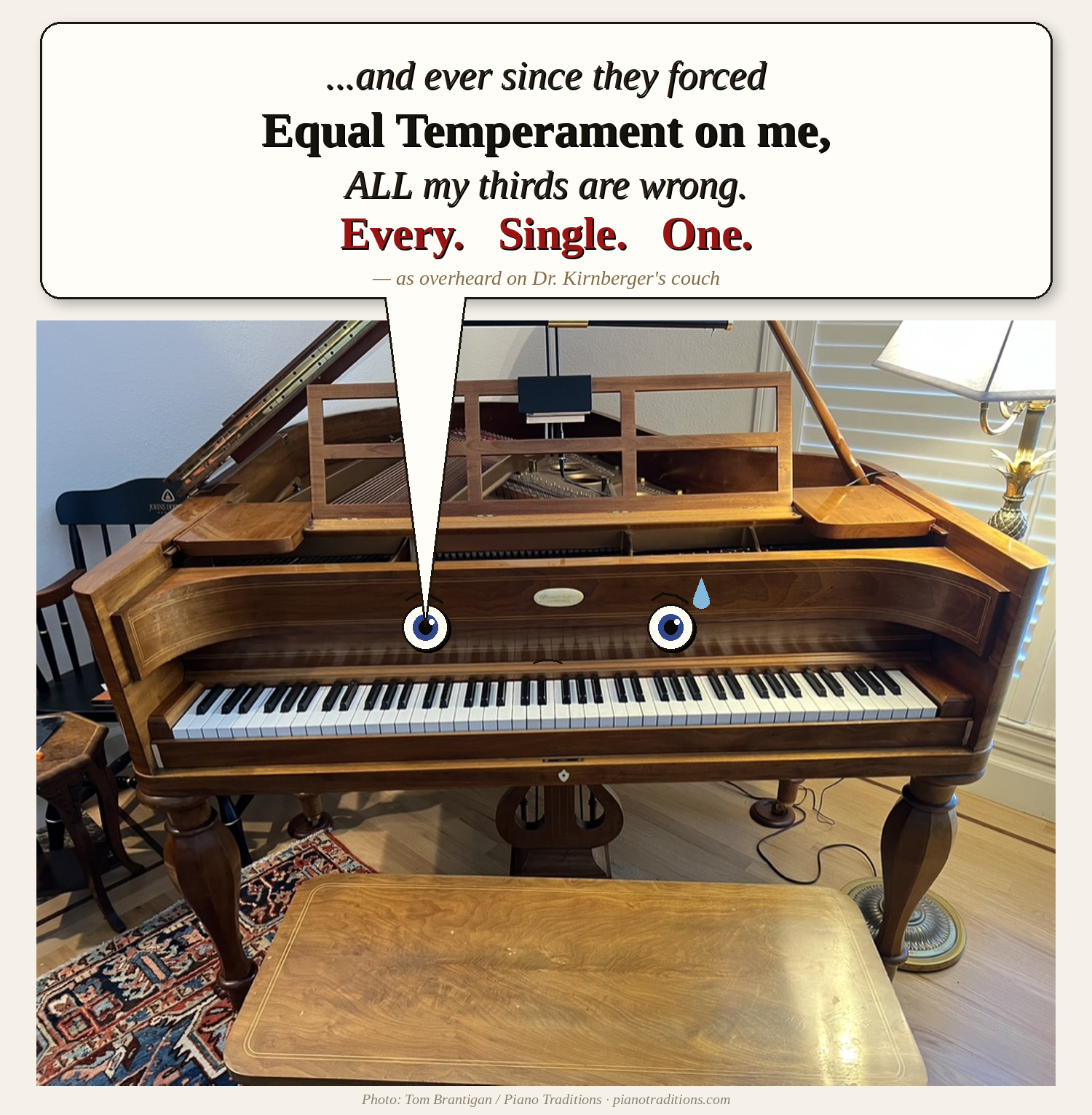
Equal temperament makes every key equally tolerable — and equally colorless.
Here's what we gave up, why Bach and Chopin heard something entirely different, and why it still matters.
Every piano I tune is tuned to a lie.
That's a deliberately provocative way to open, and I mean it only half-seriously — but only half. Equal temperament, the system I use on every piano in every home and concert hall in the Western world, is built on a mathematical impossibility that we have all agreed, by convention, to pretend doesn't exist. Understanding that impossibility — and understanding what musicians did before they accepted it — is one of the most illuminating things a piano lover can explore.
If you haven’t heard about anything other than equal temperament, this should be particularly interesting. But first, start with equal temperament itself and what it is.
The Lie We Tuned Into
Acoustics & History
Equal temperament makes every key equally tolerable — and equally colorless. Here's what we gave up, why Bach and Chopin heard something entirely different, and why it still matters.
Let me start by saying that I have two grand pianos at home, a Mason & Hamlin and a 1916 Steinway. Since I have two grands, I have the luxury of trying out different tunings just to hear what difference it makes in the music I play. From that standpoint, here are my thoughts on differences to approaches in tuning and why pianos simply can’t really be in tune in all keys.
Every piano I tune is tuned to a lie. That's a deliberately provocative way to open, and I mean it only half-seriously — but only half. Equal temperament, the system used on every piano in every home and concert hall in the Western world, is built on a mathematical impossibility that we have all agreed, by convention, to pretend doesn't exist. Understanding that impossibility — and understanding what musicians did before they accepted it — is one of the most illuminating things a piano lover can explore. It’s a little esoteric but also very interesting if you like pianos – which you must since you are reading this.
Let me start with the physics, because the lie begins there.
The Overtone Series Never Promised Us a Keyboard
When a piano string vibrates, it doesn't vibrate at just one frequency. It vibrates at its fundamental pitch and simultaneously at a whole cascade of higher frequencies called overtones or harmonics: the octave, the octave plus-fifth, the double octave, the double-octave-plus-third, and so on. This series is not a human invention; it's a physical fact of how tensioned strings — and all resonating bodies even organ pipes — behave. Understanding the overtone series and how it works is essential to understanding equal temperament or any other temperament for that matter.
Two notes sound consonant, smooth, without beating or roughness, when their overtones align cleanly. A perfect fifth — C and G, for example — can sound pure because the second harmonic of G lands exactly on the third harmonic of C. A perfectly pure major third sounds breathtakingly clear because the fifth harmonic of the lower note aligns with the fourth harmonic of the upper. But that’s not what you get with equal temperament.
This concept is the basis of everything that follows: pure intervals are defined by simple whole-number ratios. A pure octave is exactly 2:1, for instance the second harmonic of C equals the first harmonic of the C an octave above. Note that we consider the base note as the first harmonic. A pure fifth is exactly 3:2. A pure major third is exactly 5:4.
The “Commas” and Why Pure Intervals Can’t Co-exist
Start on C and tune twelve perfectly pure fifths upward (each ratio of exactly 3:2), and you expect to land back on C, seven octaves higher. But you don't. You overshoot by a small but audible interval called the “Pythagorean comma”.
The difference — about 23.5 cents, nearly a quarter of a semitone — must be absorbed somewhere in the twelve-note system. If you calculate pure major thirds, you arrive at an interval that is roughly 21.5 cents wider than pure. This is the “syntonic comma”.
These two commas are not tuning errors. They are mathematical inevitabilities — the universe's way of telling us that a finite keyboard with twelve notes per octave cannot simultaneously have all pure fifths and all pure thirds.
Something must give. The entire history of Western temperament is the history of deciding what gives, and by how much.
Equal Temperament's Elegant Solution: Spread the Pain Equally
Equal temperament solves the comma problem with the mathematical equivalent of a controlled demolition: it distributes the Pythagorean comma evenly across all twelve fifths, shrinking each fifth by 1/12 of a comma, approximately 1.05946.
The result is a system of remarkable symmetry. Every key is in exactly the same relationship to every other key. C major and F# major are tuned identically, just shifted. A piece can be transposed to any key without changing its character at all, because all keys have been made identical. Modulation is frictionless. The piano can play in any key equally well. The cost is that it plays in every key equally badly.
For wind players and some singers, this is really annoying and leads them to have to bend the pitches up or down to try to match the piano’s out-of-tuneness. Early music singers who sing with pure non-vibrato sounds, hate singing with a piano because they tune intervals perfectly on their own and clash with an equal temperament piano.
Consider the major third — the interval that most defines whether a chord sounds warm and consonant or cold and agitated. In equal temperament, the major third is not pure. In equal temperament, every major third is 400 cents. A pure major third is 386 cents. That's a discrepancy of 14 cents, and it means that every major third on every equally-tempered piano beats — vibrates with a beat at roughly 7–14 times per second depending on register. In terms of pure tuning, not equal temperament tuning, the 3rd is out of tune. It sounds bad. Then again, the equally tempered major third has become so normalized that most modern listeners no longer consciously notice it, but it is there, a permanent low-grade acoustic friction in every major chord.
Equal temperament is also a relatively late arrival in piano history. It was theoretically understood in the 16th century, but it didn't become the dominant standard in Western Europe until the mid-to-late 19th century. When Chopin was composing in the 1830s and 1840s, equal temperament was still a contested newcomer. When Bach was writing the Well-Tempered Clavier in 1722, equal temperament was one theoretical option among several, and almost certainly not what he had in mind.
Well Temperaments: Distributing the Comma with Intent
Before equal temperament, keyboard instruments were tuned in what we now call well temperaments — systems that, like equal temperament, spread the Pythagorean comma across the twelve fifths, but spread it unevenly, according to a deliberate musical philosophy.
The governing insight of all well temperaments is this: if the comma must go somewhere, put most of it where it will be heard least. Concentrate the purest fifths and the calmest thirds in the most commonly used keys — C, G, F, D — and push the rougher intervals toward the remote keys that composers visit rarely. The result is a system where every key is usable (no key sounds badly out of tune), but no two keys sound identical. Each key has a distinct harmonic personality, a particular blend of purity and tension.
This is the concept of key color — the idea that E-flat major and E major don't just sit at different positions on the keyboard, they have different emotional textures, different acoustic characters. For composers who lived and worked inside well-tempered systems, key color was a real compositional tool, as tangible as dynamics or articulation.
Andreas Werckmeister and the Keys Bach Knew
Andreas Werckmeister, a German organist and theorist, published his influential treatise Musicalische Temperatur in 1691, outlining several well-temperament schemes. The most famous, now called Werckmeister III, distributes the Pythagorean comma among four fifths: C– G, G–D, D–A, and B–F#. Each of these is narrowed by ¼ comma; all remaining fifths are left pure.
The effect is to give the "white key" home keys — C, G, D, F, A — very pure thirds and stable, resonant fifths. As you move around the circle toward the sharper keys, the thirds gradually widen and the music takes on a certain tension. The most remote keys — C# minor, F# major, B major — have noticeably wider thirds and a more tense instability. To our ears, they sound more out of tune than the home keys.
Was Werckmeister III specifically what Bach used? Perhaps. He never really told us. What we can say with confidence is that Bach composed for a well-tempered keyboard instrument where Werckmeister was popular. The title Das Wohltemperierte Clavier — The Well Tempered Clavier — is itself a statement of intent: Bach was demonstrating that a well-tempered instrument could produce expressive, fully-realized music in all twenty-four major and minor keys. The progression through the keys in the WTC isn't random. C major opens with crystalline simplicity; C# minor is already darker and more introspective; F# major has an intense quality; B-flat minor is dense and searching.
Where wasn’t any question that he could compose in any key he wanted so why write a collection of pieces that covered every major and minor key. He wanted to show the difference in color of the various keys.
Thus, Bach’s “Well Tempered Clavier” wasn’t an “Equal Tempered Clavier”. They are very different even though most people still play those pieces on an equal temperament tuned piano. They probably don’t know they are missing something.
Johann Philipp Kirnberger and the Keys Chopin Chose
Johann Philipp Kirnberger was a student of Bach, and his temperament systems — particularly Kirnberger III published in 1779 — reflect a philosophy of preserving as much harmonic purity as possible in the home keys while still achieving twelve-note usability.
Kirnberger III takes a different approach from Werckmeister. It places four pure fifths at E–B, B–F#, F#– C#, and C#–G#, and distributes the comma primarily across the C–G–D–A–E chain. The result is that C major and G major have nearly pure major thirds (C major's third beats very slowly — practically indistinguishable from pure at normal listening distances), while the sharp keys, paradoxically, are also reasonably calm. The most tempered intervals cluster in a band around A and D.
Chopin's relationship to Kirnberger III is documented in a remarkable way: it appears in the tuning instructions used by his preferred piano tuner and close associate.
A composer like Chopin was certainly sensitive to timbre was almost certainly hearing, and composing into, the key colors his Kirnberger III temperament provided. Chopin was painting with a palette that no longer exists on the modern concert grand. When you compose in a well-tempered versus equal tempered approach, the composer may start in a key that is very much in tune, modulate to a key that isn’t and thus causes tension, and then back to the original key which now, calmly settles back into a feeling of serenity. This is lost in equal temperament.
Though Chopin never described it in this way, Christian F.D. Schubart described certain key colors in the following way:
C major Completely pure. Its character is innocence, simplicity, naiveté
C minor Declaration of love and at the same time the lament of unhappy love.
D major The key of triumph, of Hallelujahs, of victory-rejoicing.
D minor Melancholy and human brood
E major Noisy shouts of joy, laughing pleasure, and not yet complete
E minor Naïve, womanly innocent declaration of love, lament without grumbling. This key speaks of the imminent hop of resolving
in the pure happiness of C Major
Take some time and ask Google to show you the entire list from Schubart who wrote them around 1874.
How They Sound to Modern Ears
If you have never heard a piano tuned to a well temperament, the first experience is genuinely startling — and then, for most people, quietly beautiful in a way that's hard to articulate immediately.
The most immediate difference is in the major triads of the home keys. In equal temperament, every major chord beats and sounds the same. It's a sound we've normalized so thoroughly that most of us don't consciously register it as beating or out of tune — it simply sounds like "a chord." But in Kirnberger III, a C major chord blooms into near-silence. The beating slows almost to zero. It has a quality of physical warmth and depth that the same chord on an equally-tempered piano lacks — and this is not romanticization or placebo. It is acoustics. The overtones are aligning more cleanly.
Then you move to a remote key — F# major, say — and the quality shifts. The thirds widen. A certain brightness or urgency enters, which to modern ears can sound "almost out of tune" at first. But after ten minutes inside a well-tempered world, you stop hearing it as an error and start hearing it as expression. The music itself seems to be communicating emotion.
Equal temperament erased key color to solve a practical problem. What we gained was unlimited modulation. What we lost was the acoustic map that composers had been navigating for two centuries.
From my Perspective as a Pianist
The experience of listening to Bach's WTC on a well-tempered (not equal temperament) instrument is particularly revelatory. The famous C major Prelude, Book I, has a different quality — more open, more simply consonant — than it does in equal temperament. By the time you reach the C# minor Prelude and Fugue, there's a perceptible change in the character of the sound itself: the thirds are wider, the harmonies carry more friction, and the emotional weight is partly a product of the tuning, not just the notes. Bach didn't need to write an instruction saying, "this piece is dark and troubled." The instrument's acoustic character did some of that work.
I currently have my Mason & Hamlin tuned in Kernberger III since I have recently been playing multiple pieces by Chopin. Chopin nocturnes in Kernberger III acquire a depth of consonance in their home keys that makes the equal-tempered version sound stiff, plain, and out of tune.
Why This Matters — From the Tuner's Perspective
As a working piano technician, I tune in equal temperament every day, and I will continue to do so. It is the right standard for an instrument that might accompany a jazz combo in the morning, rehearse a Brahms sonata in the afternoon, and play a movie score at night. The flexibility equal temperament provides is a genuine achievement.
But knowing the history changes how I hear the instruments I work on, and how I think about the composers whose music those instruments play. When I'm regulating a piano and listening to the thirds in the middle octaves — checking whether the voicing brings them forward or lets them settle back — I'm aware that every one of those thirds is 14 cents too wide. The piano is doing its best with a mathematical compromise that was accepted long after the great composers had already written their masterworks.
If you want to hear Chopin on a Kirnberger-tuned piano, recordings exist, and they are worth seeking out. The experience doesn't make equal temperament sound wrong, exactly — but it does make you understand, for the first time, what the word temperament really means.
It means compromise. And the nature of the compromise shapes the music in ways that go all the way down to the physics of a vibrating string.
The piano you have in your living room is tuned to a lie. It's a beautiful, practical, universally useful lie. But Bach and Chopin lived somewhere else — somewhere more particular, more colored, more acoustically true in the places they loved most — and their music still carries the ghost of that world.